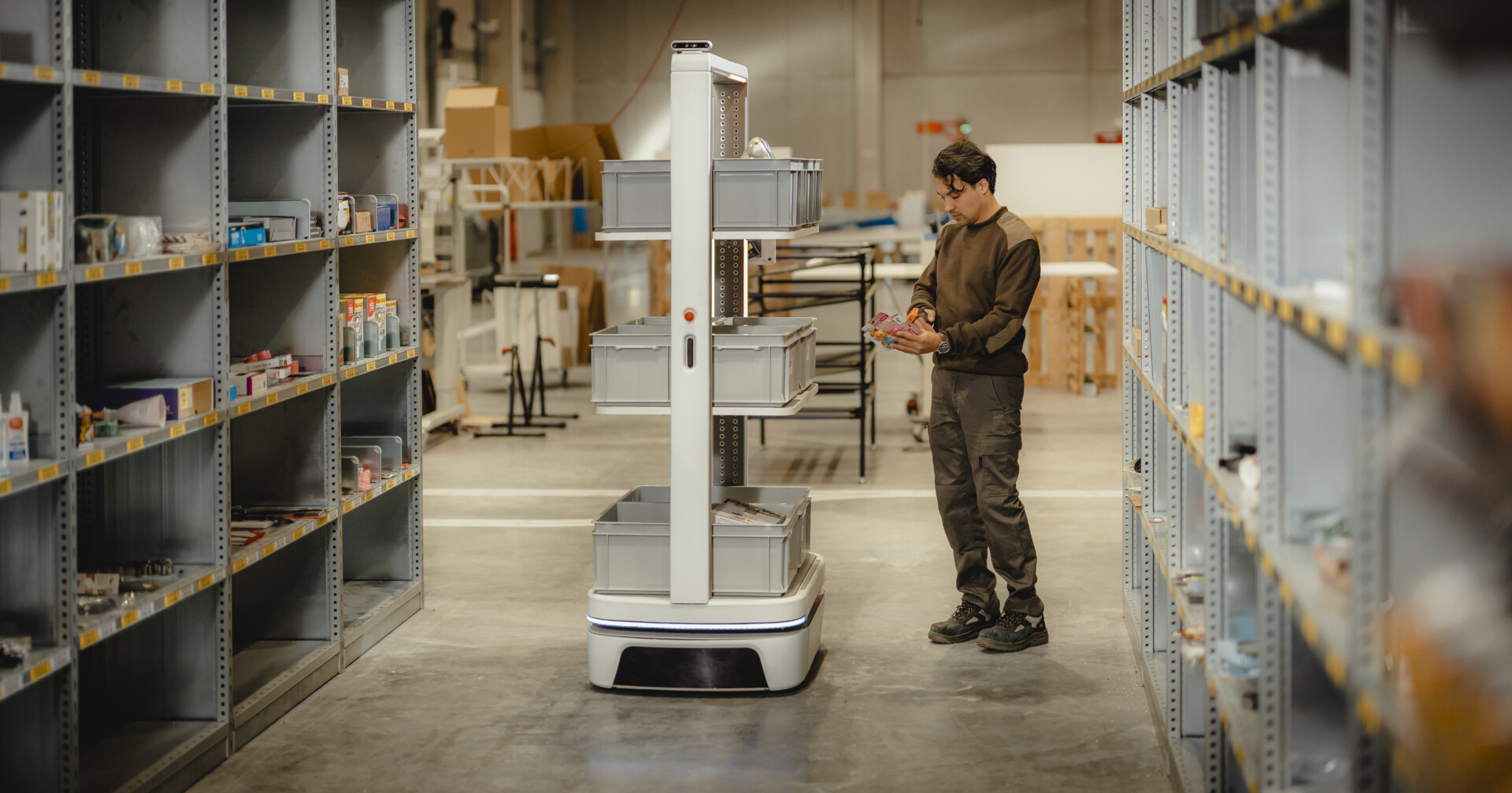
The logistics sector is changing rapidly. E-commerce, shorter delivery times and increasing pressure to improve efficiency mean that warehouses are constantly looking for smarter ways of working. Automation is playing an increasingly important role in this, but the question is no longer whether we should automate. The question is how we can deploy technology in such a way that it truly adds value on the shop floor.
The Zeal Runner, developed by Zeal Robotics in collaboration with Comate, is an interesting example of this.
The autonomous mobile robot was designed to assist order pickers and take over repetitive transport tasks. But what makes the Zeal Runner interesting is not just the technology behind it. It is, above all, the way in which robotics, industrial design and ease of use come together in a single solution.
Robotics that works alongside people
The future of warehouse automation is increasingly moving away from fully enclosed, automated systems. In many warehouses, people continue to play a crucial role. Robots must therefore not only be efficient, but also be able to work alongside people in the same space.
This calls for a different approach to design. Safety, navigation, speed, ergonomics and user experience become just as important as the robot’s technical performance.
The Zeal Runner was developed with this in mind. The result is a compact and manoeuvrable robot that moves nimbly through warehouses and is designed to adapt to the day-to-day realities of order pickers.
From prototype to industrial solution
Zeal Robotics approached Comate with a clear ambition: to develop a new generation of order-picking robot that better reflects the realities of modern warehouses. A small-scale prototype already existed, but further engineering was required to turn that initial vision into a fully-fledged robot.
Comate brought together a range of specialist skills. Mechanics, electronics, product design, usability and production were approached in an integrated manner right from the start. This meant that consideration was given not only to what the robot needed to be capable of from a technical perspective, but also to how it would behave in a busy warehouse and how people would work alongside it.
A key example is navigation. The Zeal Runner needed to be able to react safely to obstacles whilst remaining affordable. Whereas many similar systems use multiple scanners, the aim for the prototype phase was to find a smarter solution using a single scanner. By cleverly combining the hardware and software, the robot was able to monitor a 270-degree field of view with a single scanner, without compromising the strength of the frame.
The design has also evolved in line with the technology. The robot not only had to be high-performing, but also accessible and pleasant to work with. Its rounded shapes and friendly appearance contribute to safe and intuitive interaction with order pickers. Furthermore, the housing was developed with a view to larger-scale production.
From technological innovation to practical innovation
That is perhaps the most important lesson to be learnt from the Zeal Runner. Innovation does not always have to mean inventing a completely new technology. It can also mean using existing technology in a smarter, more accessible way.
By bringing together hardware, software, engineering and design right from the start, we create a product that is not only technologically interesting but also fits in with existing logistics processes.
And according to Comate, that is precisely where the key to successful innovation lies: developing technology that is not only impressive in a demo, but reliable, scalable and usable in practice.
Award-winning design as a mark of recognition
This integrated approach was also recognised by the international design community. In 2025, the Zeal Runner won an iF Design Award, in recognition of the strong interplay between functionality, usability, technical innovation and design.
The award-winning design is therefore more than just attractive packaging for the technology. It demonstrates how a well-designed industrial solution can make complex technology more understandable and accessible to the people who work with it.
For the logistics sector, this offers an interesting glimpse into the future: not humans or machines, but technology that enables people to work more intelligently and efficiently.
The Zeal Runner is one of three innovative projects that Comate will be presenting at Transport & Logistics on 22 September at 2.00 pm during ‘Behind the design: cases that move’, organised by the Flanders District of Creativity.